

A meaningful tattoo does not need to illustrate every chapter of your life. In fact, the strongest work often begins when you stop asking for a literal collage and start asking how to create a custom tattoo story with a clear emotional center. A single peony, tiger, ship, or swallow can carry more weight than a page of dates and quotes when it is chosen and composed with intention.
Custom tattooing is a collaboration. You bring the experiences, references, memories, and feeling. Your artist translates those raw materials into a design that reads clearly on the body, fits the chosen style, and will still hold visual power years from now. The goal is not to explain your entire life to a stranger. The goal is to wear a piece of art that feels unmistakably yours.
Start With the Feeling, Not the Symbol
Most people begin with a symbol: a dragon for strength, a rose for love, a compass for direction. Symbols can be useful, but they are only the surface. Two people may want a dragon for completely different reasons, and those differences should shape the design.
Before collecting images, identify the emotional truth behind the tattoo. Maybe it marks rebuilding after loss, devotion to family, a hard-won sense of independence, or a place that changed your life. Try finishing this sentence: “I want this tattoo to remind me that…” That answer gives the concept its foundation.
Then think about the moments, people, or places connected to that feeling. You do not have to include each one visually. A client honoring a late grandfather may not need a portrait, a name, and a birthdate. The story may be better expressed through a tool he used, a flower from his garden, or an animal that reflects his character. Indirect symbolism often feels more personal because it leaves room for your own memory.
Choose Symbols With Real Personal Weight
Once the core feeling is clear, select two or three visual elements that support it. Restraint matters. A tattoo gains impact when each element has a job to do, rather than competing for attention.
For example, a story about protecting a young family could become a guardian lion with peonies, rather than a literal scene of every family member. A period of change could be expressed through a koi moving upstream, with water creating direction and movement through the piece. A Neo-Traditional design might use a dagger, swallow, and rose, but the color palette, facial expression, placement, and composition can make that familiar vocabulary deeply individual.
It also helps to separate symbols into three categories: the main subject, supporting imagery, and atmosphere. The main subject carries the central idea. Supporting imagery adds personal context. Atmosphere includes elements such as wind bars, waves, smoke, clouds, leaves, or ornamental framing that bind everything into one tattoo.
Be Thoughtful With Japanese Imagery
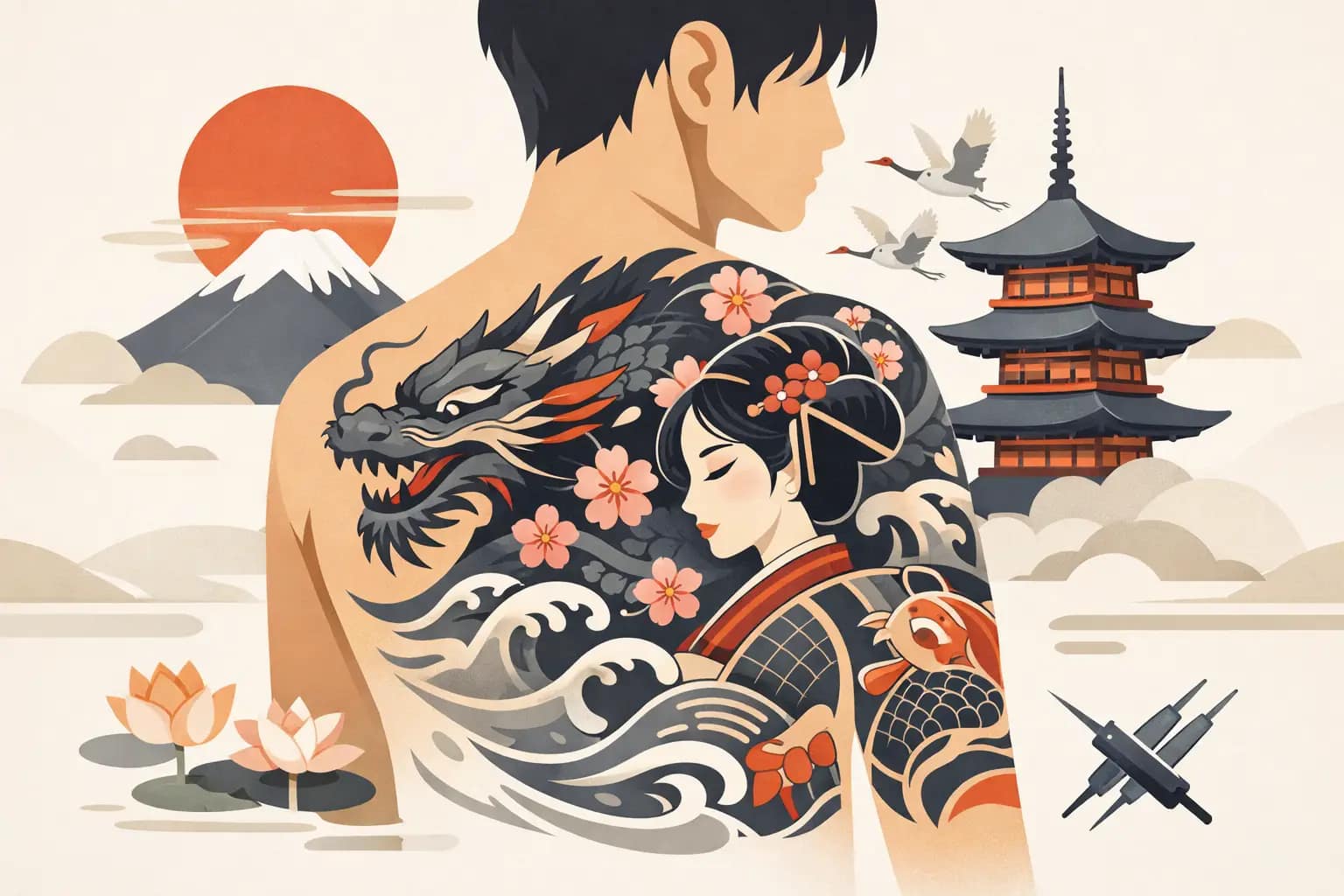
Japanese and Irezumi-inspired tattooing has a rich visual language, and its imagery is especially powerful when approached with respect. Dragons, snakes, tigers, masks, koi, chrysanthemums, peonies, and waves are not random decorations. They have established associations, seasonal relationships, and compositional traditions that can guide a design.
That does not mean your tattoo has to follow a rigid formula. It does mean an experienced artist can help you make choices that feel visually and culturally considered. A Japanese-inspired sleeve works best when the imagery is developed as one connected field, not as separate sticker-like pieces placed beside one another.
If a particular image speaks to you, explain why. Your reason may be personal, while your artist can advise on how that idea fits the larger visual language. This is where specialized knowledge makes the difference between a tattoo that references a style and one that carries its rhythm, balance, and authority.
Let Placement Shape the Story
The body is not a flat page. A design that looks great in a square reference image may lose energy once it wraps around an arm, bends across a knee, or moves over the shoulder. Placement should be part of the story from the beginning, not an afterthought.
A forearm can suit an image with a strong vertical flow, such as a snake, sword, or climbing flower. A chest piece gives room for symmetry and a direct, protective presence. A back offers a large canvas for a full narrative, while a sleeve can create a journey that reveals itself as the arm turns.
Think about how visible you want the tattoo to be and how much room the concept needs. A small piece can be intimate and elegant, but it cannot hold the same level of detail as a larger composition. Trying to force too much into a limited area usually leads to crowded linework, muddy shading, and details that disappear as the tattoo ages.
Scale is not about making something bigger for the sake of it. It is about giving the idea enough breathing room to remain readable. For a tattoo intended to last decades, negative space is just as valuable as detail.
Build a Reference Board Without Designing the Tattoo Yourself
References are useful when they communicate taste, not when they demand an exact copy. Bring examples of color palettes, body placements, line quality, mood, or movement that appeal to you. A photo of a stormy coastline may explain the energy you want better than ten tattoo screenshots.
Avoid assembling a design from pieces of other artists’ tattoos. Your artist needs room to create an original composition that works for your body and chosen concept. A good reference board says, “I like this atmosphere, this level of contrast, and this sense of movement.” It does not say, “Recreate this person’s tattoo with one element changed.”
Include references outside tattooing whenever possible: family photos, old letters, botanical images, architecture, album covers, films, or objects with sentimental value. These details give your artist something genuine to interpret. They also help move the conversation beyond trends.
Bring the Right Information to a Consultation
A productive consultation is not a test where you need to arrive with a finished design. It is a conversation where clarity saves time and leads to stronger art. Share the story behind the piece, your preferred placement and approximate size, the styles you are drawn to, and any non-negotiable elements.
Be equally honest about what you do not want. Perhaps you dislike heavy black backgrounds, want to avoid overly realistic imagery, or need the design to remain easy to cover for work. Those boundaries are valuable. They help an artist create within the space that feels right for you.
At Dani Olmos Tattoo, the custom process is built around this exchange: your vision, the artist’s design judgment, and a shared commitment to a tattoo that holds up over time. The best consultation leaves you feeling heard, but it should also include professional guidance. If an artist recommends simplifying a concept, increasing the scale, changing the placement, or replacing an element that will not age well, that is craftsmanship protecting the final result.
Trust the Composition More Than the Checklist
A personal tattoo does not become more meaningful because it contains more information. It becomes meaningful when the composition creates a feeling each time you see it. This is especially true with larger Japanese and Neo-Traditional work, where flow, contrast, and hierarchy determine whether the piece feels unified.
Let the primary image remain primary. Give secondary elements a supporting role. Allow open skin, background, and color contrast to direct the eye. A skilled artist may remove an idea you initially thought was essential, not because your story matters less, but because the remaining elements tell it more clearly.
This can be the hardest part of a custom process. You may feel attached to every reference or symbol. But a tattoo is not a scrapbook. It is a permanent composition, and every decision should serve the piece as a whole.
Plan for the Tattoo You Will Live With
Long-term quality is part of the story. Fine details, pale colors, tiny lettering, and dense clusters of imagery all come with trade-offs. Skin changes, sun exposure happens, and tattoos naturally settle over time. Bold structure, intentional line weight, readable shapes, and well-placed negative space give a design the best chance to age with strength.
This does not mean every tattoo must be dark or simple. It means the level of detail should match the size, placement, and style. An artist can build texture and nuance without sacrificing legibility. If your concept deserves a larger canvas or multiple sessions, giving it that space is often the better investment.
Your story is already yours. The custom tattoo process is about finding the visual language worthy of carrying it. Come prepared to share the meaning, stay open to expert direction, and choose the version of the idea that will still feel like art when the memory behind it has become part of your history.