
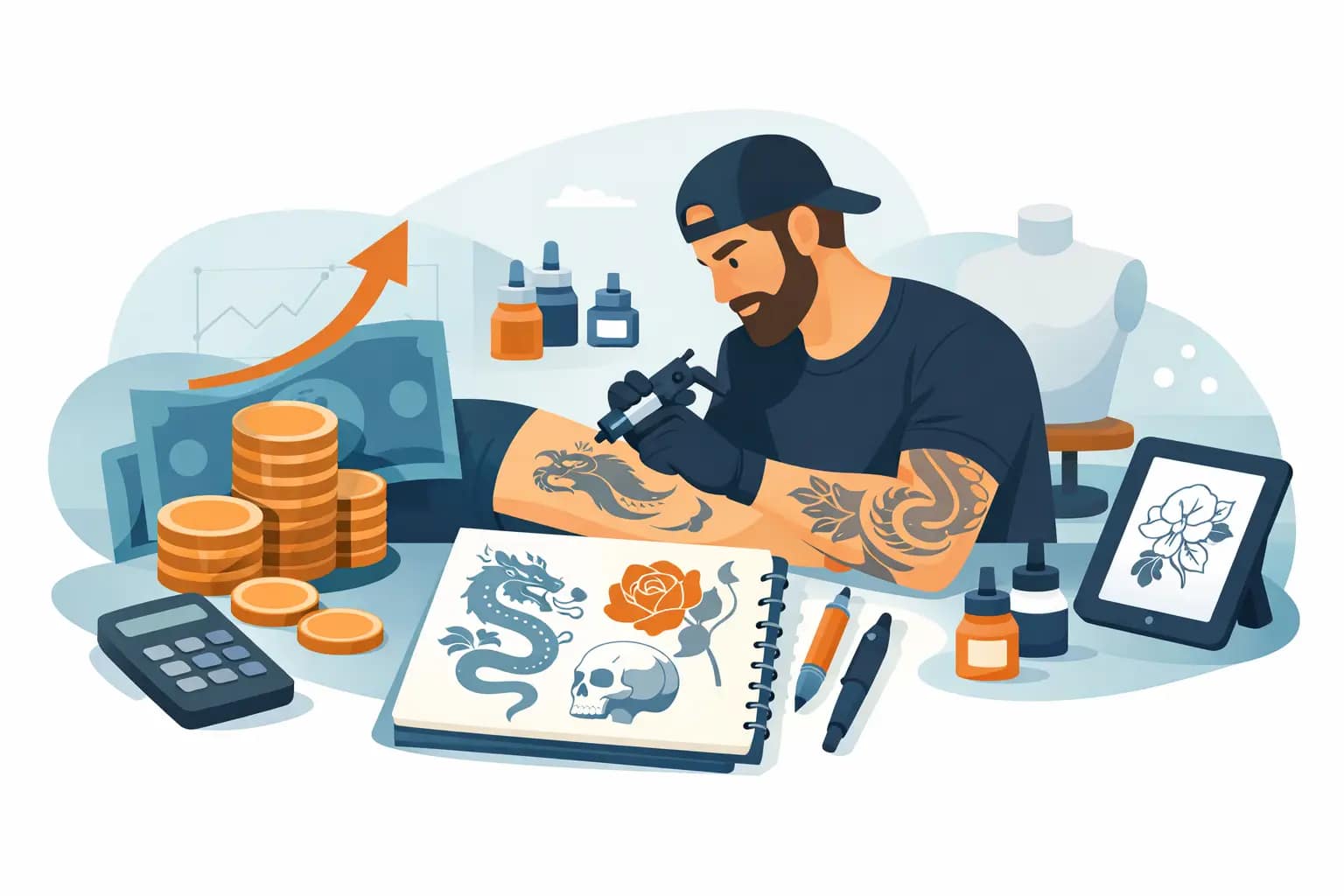
Sticker shock usually hits before the stencil does. A client sees one tattoo priced one way, another priced much higher, and asks the obvious question: does custom tattoo cost more? In most cases, yes. But the better question is what that higher price actually buys – and whether it creates better value for the piece you’ll wear for years.
Does custom tattoo cost more than flash?
Most of the time, a custom tattoo costs more than a flash design or a simple standard piece. That’s not because custom work is priced to feel exclusive. It’s because the artist is doing far more than tattooing on the day of your appointment.
With custom work, the process starts well before the machine turns on. There’s concept development, reference gathering, composition planning, body flow, stylistic decisions, and revisions shaped around your idea and your anatomy. If the tattoo is meant to carry personal meaning, the artist also has to translate a story, theme, or emotion into something that works visually as a tattoo – not just as a sketch.
That takes time, experience, and a strong point of view. A custom tattoo is not pulled from a wall, resized, and repeated. It is built for one person.
What you’re really paying for
The biggest difference in price is design labor. When you commission a custom tattoo, you are paying for original creative work before the tattoo session even begins. For artists who specialize in Japanese, Irezumi-inspired, or Neo-Traditional work, that design phase can be especially involved because balance, movement, symbolism, and readability all matter.
A strong tattoo has to do more than look good in a flat image. It needs to sit correctly on the body, hold visual power from different angles, and age well over time. That means the artist is considering line weight, spacing, contrast, negative space, and how details will settle in the skin years from now.
This is where custom pricing starts to make sense. You are not only buying hours. You are buying judgment. A seasoned artist knows what to simplify, what to emphasize, and what will still read clearly after healing and aging.
Why some custom tattoos cost much more than others
Not all custom pieces live in the same pricing range. One custom tattoo might be only modestly more than a pre-drawn design. Another might cost significantly more. The difference usually comes down to complexity, scale, placement, and the level of artistic development involved.
A small custom piece with a clean concept can be relatively straightforward. A large back piece, sleeve, or chest panel rooted in Japanese composition is another story. Those projects require deep planning. The artist has to think about how major elements interact, how background supports the focal imagery, and how the whole piece moves with the body instead of fighting it.
Placement changes everything too. Tattooing a flat outer forearm is not the same as designing for ribs, hands, knees, or a wraparound shoulder. Difficult placements often require more strategic drawing and more technical tattooing, which can affect price.
Then there’s detail. More detail does not always mean better, but when a design calls for layered texture, ornament, or nuanced shading, it naturally takes more time to execute well.
Custom doesn’t just mean “you picked the idea”
This is where confusion happens. Some clients think a tattoo is custom because they chose the subject matter. That’s only part of it.
A truly custom tattoo is developed specifically for you. That includes the concept, the composition, the way the tattoo fits your body, and the stylistic choices that make it feel cohesive rather than generic. Two people can both ask for a dragon, tiger, snake, or peony. One version might be a loosely adapted idea. The other might be fully designed around scale, motion, symbolism, and body flow.
That second version is where the greater value usually lives. It feels intentional because it is intentional.
Why artist specialization affects the price
If you’re booking with a specialist, the price may be higher than with a generalist shop, and that can be completely justified. Specialization matters in tattooing the same way it matters in any craft. When an artist has spent years refining a certain visual language, clients are paying for consistency, technical control, and a developed artistic voice.
Japanese and Neo-Traditional tattooing are especially good examples. These styles are not only about bold imagery. They rely on structure, rhythm, contrast, and a sense of visual hierarchy. If those elements are off, the tattoo may still look busy or impressive at first glance, but it won’t carry the same clarity or longevity.
A specialist often charges more because the work reflects deeper study and a more refined process. You are paying for fewer mistakes, stronger design decisions, and a tattoo that feels complete rather than assembled.
Does a higher price always mean a better tattoo?
No. Expensive does not automatically mean excellent. There are overpriced tattoos just like there are underpriced ones.
That said, very low pricing on custom work should make you pause. If an artist is offering highly personalized design, extensive consultation, and strong technical execution at bargain rates, something usually gives. It might be rushed design time, weaker composition, inconsistent application, or limited experience.
The goal is not to find the highest number. It’s to find pricing that reflects real skill, real process, and real care. A fair custom tattoo price should make sense when you look at the artist’s portfolio, healed work, specialization, and design quality.
How to tell if the custom price is worth it
The easiest way to judge value is to look past the initial quote and focus on outcomes. Does the artist create original work that feels distinct from piece to piece? Do the designs fit each client’s body instead of looking pasted on? Is the linework confident, the shading controlled, and the composition readable from a distance?
You should also pay attention to how the artist communicates. Good custom work usually starts with good listening. If the process includes consultation, thoughtful questions, and clear artistic direction, that’s a sign you’re not just paying for tattoo time. You’re paying for collaboration with someone who knows how to shape an idea into something stronger than the original request.
For serious collectors and first-time clients alike, that matters. A tattoo can be meaningful and beautifully made, or meaningful and poorly designed. Custom pricing is often what separates those outcomes.
When custom tattoo pricing makes the most sense
If the piece is highly visible, emotionally important, or large enough to define a major area of the body, custom work is usually the right investment. The more permanent the visual impact on your body, the more valuable thoughtful design becomes.
This is especially true for sleeves, back pieces, chest panels, and larger leg work. Those tattoos need structure. They need pacing. They need elements that support each other instead of competing for attention. Custom design is what prevents a major tattoo from feeling fragmented.
It also makes sense when you want original symbolism rather than a common image repeated across dozens of clients. If your goal is a tattoo that reflects your story while still feeling timeless, custom is rarely the place to cut corners.
When a non-custom option may be enough
Not every tattoo needs a deep concept phase. If you want something small, simple, and more straightforward, flash or a lightly modified existing design may be perfectly appropriate. There’s nothing lesser about choosing a design that already exists if you genuinely love it and it suits the placement.
For some clients, that route is more efficient and more budget-friendly. The key is honesty about your goals. If you want originality, personal symbolism, and body-specific composition, custom is worth paying for. If you mainly want a clean, classic design without extensive development, you may not need the full custom process.
A good artist will tell you the difference instead of pushing you into more than you need.
The smarter way to think about tattoo cost
Instead of asking only whether custom costs more, ask what kind of tattoo experience you want. Do you want fast and simple, or developed and personal? Do you want a design that works, or one that was built around you from the start?
That’s where the price starts to mean something. Custom tattoos usually cost more because they require more vision, more preparation, and more technical discipline. When done well, they also give you something harder to replace – a piece that feels like it belongs on your body and nowhere else.
If a tattoo is meant to stay with you for life, paying for thoughtful design is not excess. It’s respect for the art, the process, and the skin it lives in.