

A tattoo can hold a name, a turning point, a family history, or a promise you made to yourself. But a meaningful piece does not need to explain every detail at first glance. The strongest personal story tattoo design turns private meaning into clear, compelling imagery that still stands on its own as artwork.
That balance is where custom tattooing matters. A meaningful tattoo should feel unmistakably yours, yet it also has to work with the body, the style, and the realities of how ink settles over time. The goal is not to place a collection of symbols on skin. It is to create one intentional composition with presence, movement, and a story you can keep carrying forward.
Start With the Story, Not the Symbol
Clients often arrive with a symbol already chosen: a dragon for strength, a tiger for protection, a flower for a loved one, a bird for freedom. Those are useful starting points, but they are rarely the whole design.
Before choosing imagery, get specific about the experience behind it. What moment does the tattoo honor? What changed because of it? Is the feeling quiet, defiant, protective, celebratory, or reflective? A tattoo based on grief may call for a very different visual energy than one marking recovery, even if both begin with the same flower or date.
A good artist listens for the details that make a familiar motif personal. A peony can represent beauty and resilience, but its color, pairing, scale, and placement can shift its role completely. A snake may represent renewal, family protection, or a willingness to shed an old identity. The meaning is shaped through context, not just the object itself.
This is also the moment to separate what must be included from what simply feels appealing. If every memory becomes a separate visual element, the result can become crowded and lose impact. One powerful central idea, supported by a few carefully selected details, usually tells a stronger story than a literal inventory of life events.
Building a Personal Story Tattoo Design
A custom tattoo begins to take form when the story is translated into a visual hierarchy. The primary image carries the emotional weight. Secondary elements create setting, movement, or contrast. Background imagery connects the composition and helps it fit naturally across the body.
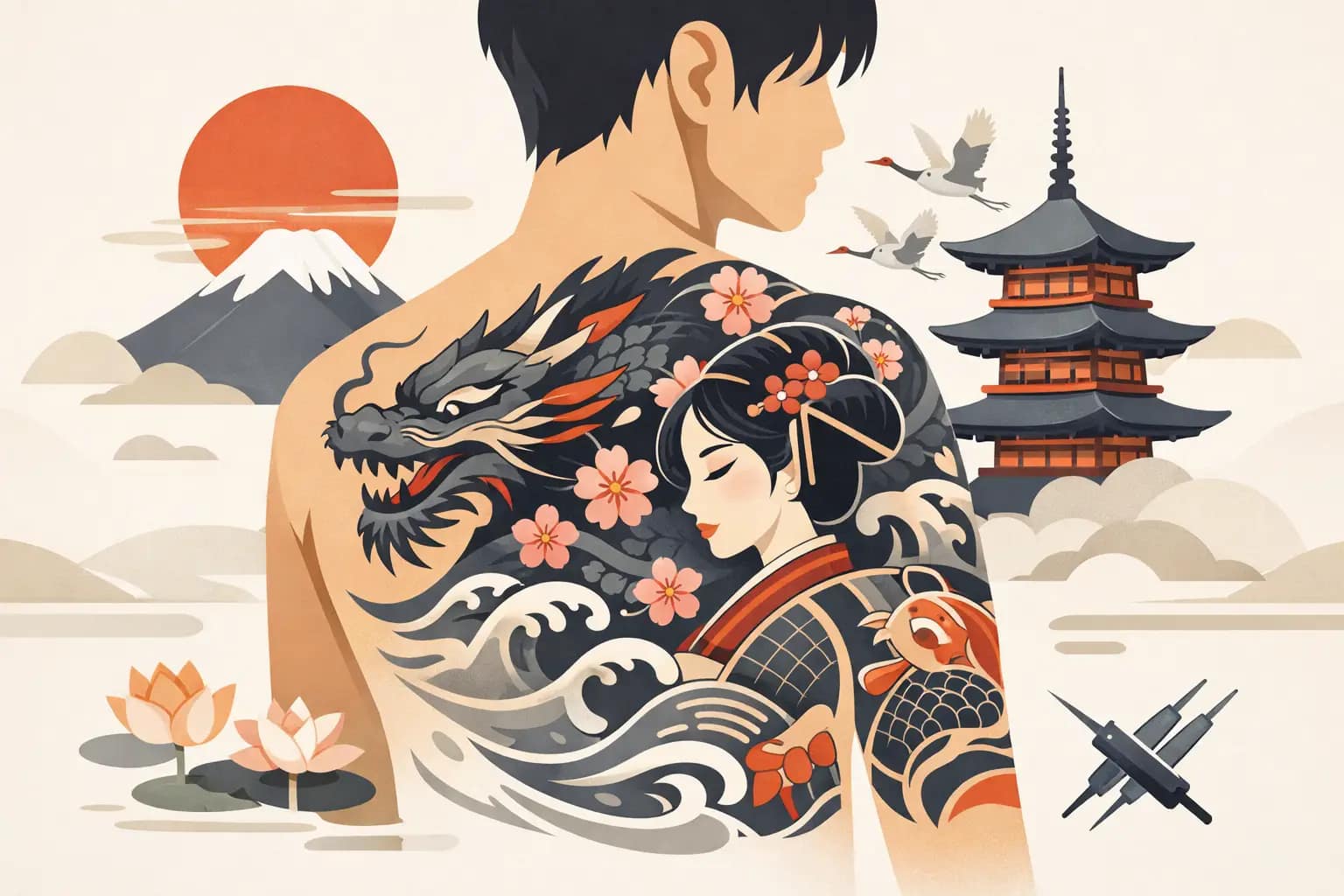
In Japanese and Irezumi-inspired work, this approach is especially valuable. Large-scale compositions often use a central subject, such as a koi, hannya, tiger, dragon, or floral arrangement, supported by elements like wind bars, waves, clouds, maple leaves, or chrysanthemum petals. These supporting forms are not filler. They create rhythm and guide the eye across the piece.
Neo-Traditional tattooing can offer a different but equally expressive route. Its bold outlines, saturated color, and illustrative forms make it well suited to personal symbols that need clarity and character. A portrait-inspired centerpiece, an animal guardian, a sentimental object, or a custom floral arrangement can feel timeless when it is designed with a confident silhouette and deliberate color choices.
The best style depends on the story and the placement. A subtle memorial may work beautifully as a focused upper-arm composition. A story about endurance, transformation, or family lineage may need the room and flow of a sleeve, chest panel, or back piece. There is no prize for going larger than the concept requires, but meaningful imagery deserves enough space to breathe.
Let Placement Shape the Composition
Placement is not the final decision after the artwork is complete. It is part of the design from the beginning.
An arm, leg, shoulder, chest, and back each move differently and offer different visual possibilities. A dragon can wrap naturally around an arm, following the curve and creating motion from every angle. A tiger may gain authority across the chest or thigh, where its face and body have room to read clearly. A floral design can soften a hard transition, connect existing tattoos, or frame a central image without overwhelming it.
For collectors building larger work over time, planning ahead is essential. A single tattoo should look finished on its own while leaving room for future expansion. Background, scale, and directional flow can make the difference between a growing collection that feels unified and one that feels pieced together.
Choose Symbolism With Respect and Intention
Japanese tattoo imagery carries deep visual and cultural traditions. When choosing Irezumi-inspired imagery, it is worth understanding the established associations of the motifs while also being honest about your own connection to them. A dragon, oni mask, koi, or hannya should not be treated as a costume or a random trend simply because it looks powerful.
That does not mean a design must follow a rigid formula. Custom work leaves room for individual meaning, especially when the artist understands both the visual language of the tradition and how to adapt it thoughtfully. The point is to make informed choices. A design becomes more compelling when its imagery, color, movement, and personal narrative support one another.
If your story calls for imagery outside Japanese tattooing, the same principle applies. Research matters. So does avoiding borrowed symbols that carry spiritual, cultural, or family significance you do not fully understand. Originality is not always about finding an image nobody has ever tattooed. Often, it comes from making sure the composition says something only you could mean.
Design for the Years Ahead
A tattoo is not a printed illustration. Skin changes, fine details soften, and areas of high friction can wear differently over time. That is why long-term visual quality has to be part of every serious design conversation.
Fine line details can be beautiful, but they are not always the right choice for every image, skin tone, placement, or scale. Tiny lettering, delicate textures, and closely packed symbols may look sharp on day one but become harder to read as years pass. Bold linework, intentional negative space, and strong contrast give a tattoo the structure it needs to age with clarity.
Color is another decision with both emotional and practical weight. A limited palette can make a piece feel focused and cohesive. Black and gray may suit a somber or understated story, while rich reds, golds, greens, and blues can bring energy to a Japanese or Neo-Traditional composition. Neither approach is automatically better. The right direction comes down to your concept, your existing tattoos, and the visual feeling you want to live with every day.
A skilled artist may recommend simplifying an idea, enlarging a detail, changing a placement, or removing an element altogether. That is not a rejection of your story. It is the design process protecting it. A tattoo should be readable from a natural distance, compelling up close, and strong enough to remain recognizable years from now.
Bring References, But Leave Room for Artistry
Reference images help communicate mood, color, placement, and the kinds of imagery you connect with. They are useful when they show what you like, but they should not become a blueprint for copying someone else’s tattoo.
The most productive consultation shares the story, the non-negotiable elements, the preferred style, the desired placement, and any tattoos that need to be considered. It also leaves space for the artist to solve the visual problem. Custom tattooing works best as a collaboration: you bring the meaning, and the artist brings the composition, technical judgment, and style-specific experience.
At Dani Olmos Tattoo, that conversation is treated as the foundation of the piece, not a quick step before the stencil. A thoughtful design process gives personal ideas the attention they need, whether you are planning your first meaningful tattoo or adding a major new chapter to an established collection.
Give the Process Enough Time
A tattoo that represents something real is worth planning carefully. Larger custom work may take more than one session, and the design itself deserves time to develop before tattooing begins. Rushing to fit every idea into a single appointment often leads to compromises in scale, placement, or clarity.
Be prepared to discuss your budget honestly as well. Cost is tied to size, detail, placement, color, session length, and the level of custom drawing involved. The better question is not how quickly the tattoo can be finished, but what the concept needs to be executed at a standard you will be proud to wear.
Your story does not need to be obvious to everyone who sees it. It needs to feel true when you see it in the mirror years from now. Start with the memory that stays with you, then give it the space, craft, and collaboration required to become art.