
A full bodysuit is not something you “add onto later” and hope it all makes sense. With irezumi, the strongest work feels intentional from the first line to the final background. If you are asking how to plan irezumi bodysuit work, the real question is how to build a large-scale piece that reads as one complete vision instead of a collection of separate tattoos.
That planning matters more than people expect. A great bodysuit is not just about picking a dragon, tiger, koi, or peony. It is about movement, negative space, how one image hands off to the next, and whether the story still feels balanced years from now. The best result comes from treating the body as a single canvas and giving the design room to breathe.
How to plan irezumi bodysuit design as a whole
The first decision is not the exact subject matter. It is the format. Are you building a traditional suit that leaves the center chest and stomach open? Are you planning a back piece first and expanding later into sleeves, ribs, buttocks, thighs, or lower legs? Are you after a classic body flow, or something more customized with neo-traditional influence?
This is where clients often rush, and it usually creates problems. If you start with isolated placements and only later decide you want a suit, the artist has to solve around choices that may not support the larger composition. Sometimes that can still work well. Sometimes it limits the strongest possible design.
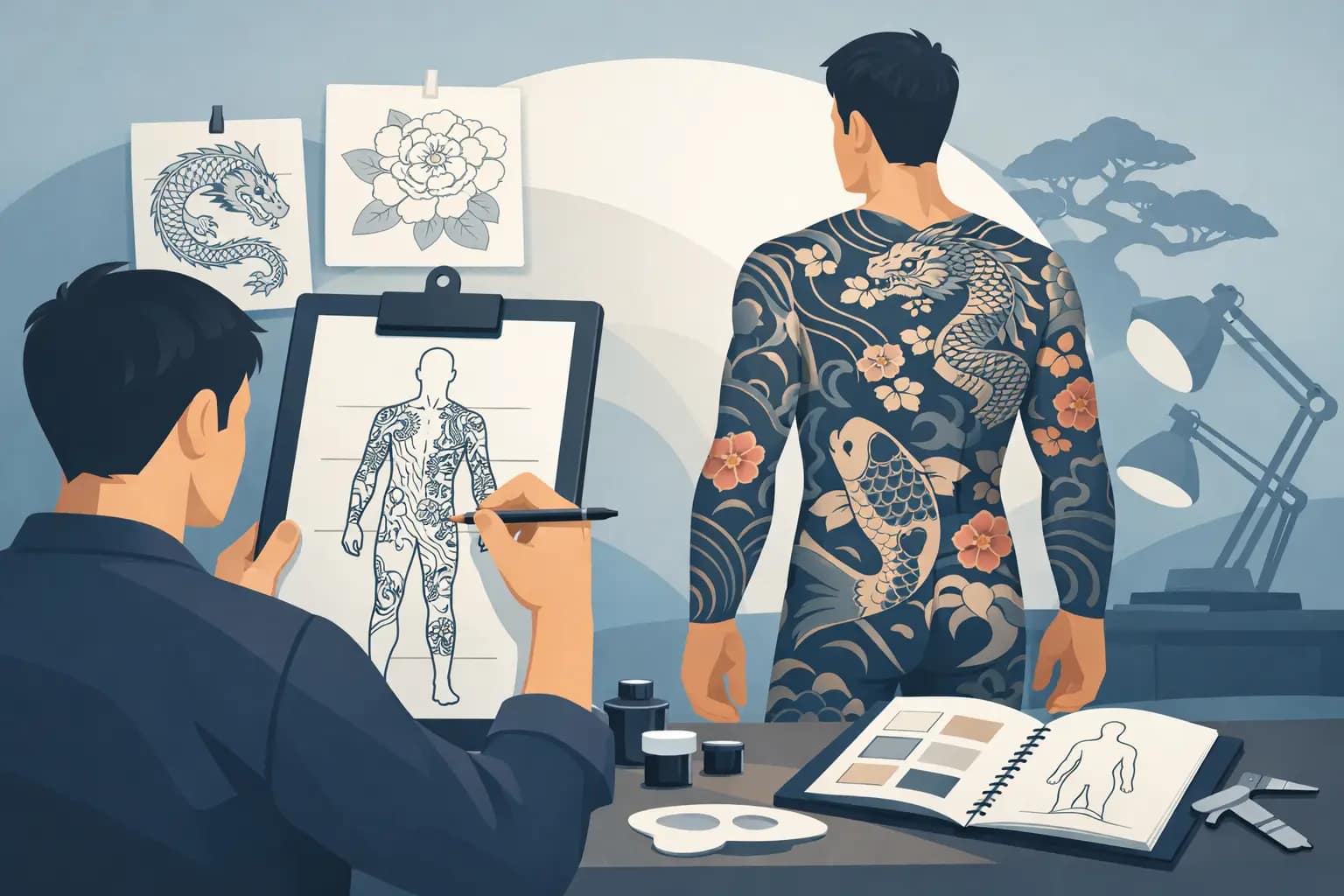
A better approach is to think in zones and transitions. The back often carries the main power image because it offers the largest uninterrupted field. The arms and legs can support secondary subjects, while wind bars, waves, smoke, rock, maple leaves, cherry blossoms, or water unify the entire body. Those background elements are not filler. They are what make the suit feel alive and connected.
Start with the main story, not random motifs
The most compelling irezumi work usually has a central narrative or emotional thread. That does not mean every piece must be literal. It means the imagery should belong together.
A dragon paired with crashing water and storm elements creates one kind of energy. A koi transforming upward with peonies and flowing current suggests something different. A tiger with bamboo and wind has a distinct mood from a phoenix with clouds and floral movement. None of these is automatically better than another. The right choice depends on what you want the suit to communicate and how much traditional structure you want to preserve.
This is where collaboration matters. A strong artist will help you narrow broad ideas into something visually coherent. If your inspiration board includes ten unrelated symbols, the job is not to force all ten into the design. It is to identify the few ideas that actually carry your story and build them into a piece that will age with clarity.
Sometimes less symbolism creates a stronger result. A bodysuit packed with too many messages can feel busy fast. One dominant theme with well-chosen supporting imagery usually reads better on skin.
Respect traditional rules, but know where you can bend them
When people think about how to plan irezumi bodysuit projects, they often land on one of two extremes. Either they want a fully traditional layout with traditional pairings, or they want total freedom and no rules at all. Most real-world projects live somewhere in between.
Traditional Japanese tattoo design has logic behind it. Seasonal elements, compatible imagery, direction of movement, and body flow all help the work feel balanced. That structure is not there to make the design rigid. It is there because it works.
At the same time, custom tattooing should still feel personal. If you want an irezumi-inspired suit rather than a strictly traditional one, there is room to adapt. Color palette, rendering style, level of detail, and certain symbolic choices can all shift toward your personal vision. The key is making those choices intentionally instead of mixing references without a plan.
A specialist can tell you when a rule is worth keeping and when it makes sense to bend it. That conversation is part of good design, not gatekeeping.
Think about body flow before individual panels
One of the biggest differences between average large-scale work and masterful large-scale work is body flow. The design should move with muscle, posture, and natural shape. It should look strong standing still, but it should also feel right when the body turns, bends, and walks.
That affects placement more than most clients realize. A face or focal point that looks centered in a flat reference may sit awkwardly on a shoulder cap or thigh. Background movement may need to wrap in a way that elongates the body rather than cutting it in half. Open skin can be just as important as tattooed skin because it creates rhythm.
This is also why planning front, back, and side views matters early. A bodysuit is experienced in motion. If the back is powerful but the side transitions feel abrupt, the whole piece can lose impact. Good planning solves that before tattooing starts.
Budget for years, not just sessions
A bodysuit is a long project. Even if you work consistently, this is usually measured in months or years, not weekends. So part of how to plan irezumi bodysuit work is being realistic about time, pain tolerance, scheduling, and budget.
The smartest clients do not ask only, “How much will the full suit cost?” They ask how the project will be paced. Some people prefer frequent sessions and want momentum. Others do better spacing appointments to recover physically and financially. Neither approach is wrong, but your artist should know which pace fits your life.
It also helps to understand that different body areas move at different speeds. The back may allow broad progress. Ribs, sternum, inner arm, knee, elbow, and certain parts of the leg can be slower and more taxing. Color saturation, background density, and detail level will also affect the timeline.
If your budget is limited, be honest about that from the start. A strong artist can help prioritize major sections in a way that still keeps the overall design intact. What you want to avoid is piecemeal decision-making that forces compromises later.
Choose the right starting point
There is no single correct place to begin, but there is usually a best place for your specific project. Many suits start with the back because it anchors the composition and sets the scale for everything else. Others begin with a sleeve or chest panel if that is the natural entry point for the design or the client wants visible progress sooner.
Starting point can also depend on your commitment level. If you know you want a full suit, beginning with a major anchor piece makes sense. If you are deeply interested but still testing your relationship with large-scale tattooing, a planned sleeve or half-back can be a more practical first stage, as long as it is designed with future expansion in mind.
That distinction matters. Starting smaller is not the problem. Starting smaller without a map is.
Your artist should shape the design, not just execute requests
The client brings the story, preferences, and commitment. The artist brings composition, technical knowledge, and long-term vision. The best bodysuits happen when both sides do their job.
If you are choosing an artist for this kind of work, look beyond individual tattoos in a portfolio. Look for consistency in large-scale design, clean movement, readable composition, and healed results that still have clarity. A bodysuit is not a collection of cool drawings. It is a system.
This is especially true with custom Japanese and irezumi-inspired work. A specialist should be able to guide you on subject pairing, transitions, color relationships, and whether your concept suits your body type and goals. That level of direction is a good sign. It means your vision is being translated into something stronger, not simply copied.
For clients in Sacramento and across Northern California who are serious about large-scale Japanese work, this collaborative process is where the tattoo starts becoming personal in a real way. Not just symbolic. Structural.
Leave room for the tattoo to age well
A bodysuit has to work on day one and ten years later. That means planning for readability, not just impact in fresh photos. Overcrowding, tiny detail in low-visibility areas, or too many disconnected focal points can reduce longevity.
Strong tattoos age well when contrast, spacing, and hierarchy are built in from the beginning. Your main images should still command attention as the skin changes over time. Background should support them, not swallow them. Color should feel deliberate, whether the palette is bold and traditional or more muted and atmospheric.
This is another reason restraint matters. Bigger work rewards confidence. It also rewards editing.
If you are serious about planning an irezumi bodysuit, think less about collecting favorite images and more about committing to a complete visual language. The right design will not just cover the body. It will belong to it.