

A lot of people think the hard part is sitting for the tattoo. Usually, the harder part comes first – figuring out what should live on your skin for years without feeling rushed, trendy, or disconnected from who you are. If you’re wondering how to choose tattoo motifs, the right answer is rarely to chase the first cool image that catches your eye. It starts with choosing imagery that can carry both visual strength and personal meaning.
A strong motif does more than look good in a reference folder. It gives the artist something solid to build from. That matters even more if you’re investing in a custom piece, where the goal is not to copy a design but to create something original that feels intentional from every angle.
How to choose tattoo motifs without forcing meaning
Not every tattoo needs a dramatic backstory. Some of the best pieces begin with a feeling, a memory, a place, or a visual language you keep coming back to. The key is knowing the difference between a motif that genuinely fits you and one that only sounds meaningful when you explain it out loud.
If you keep saving snakes, peonies, waves, masks, tigers, ravens, or daggers, pay attention to that pattern. Repetition usually says more than a random brainstorm. Your instincts often reveal your taste before your words do.
That said, taste alone is not always enough. The best motifs tend to sit at the intersection of personal relevance, strong shape, and stylistic compatibility. A symbol might mean a lot to you, but if it does not translate well visually, it may not become the tattoo you hoped for. On the other hand, a classic motif with clear structure can hold up beautifully when it is tied to your story in the right way.
Start with the story, not the object
People often begin by saying they want a wolf, a dragon, or a flower. That’s fine, but it helps to go one layer deeper. Why that image? What are you actually trying to express?
Maybe the wolf is really about protection, independence, or family. Maybe the dragon is about resilience after a difficult stretch. Maybe the flower is tied to heritage, grief, growth, or a season of life that changed you. Once you identify the idea underneath the image, you open up more creative options.
This is where custom tattooing becomes valuable. Instead of locking yourself into the first symbol you think of, you can build a motif around the meaning itself. Sometimes that leads back to your original idea. Sometimes it leads somewhere stronger and more timeless.
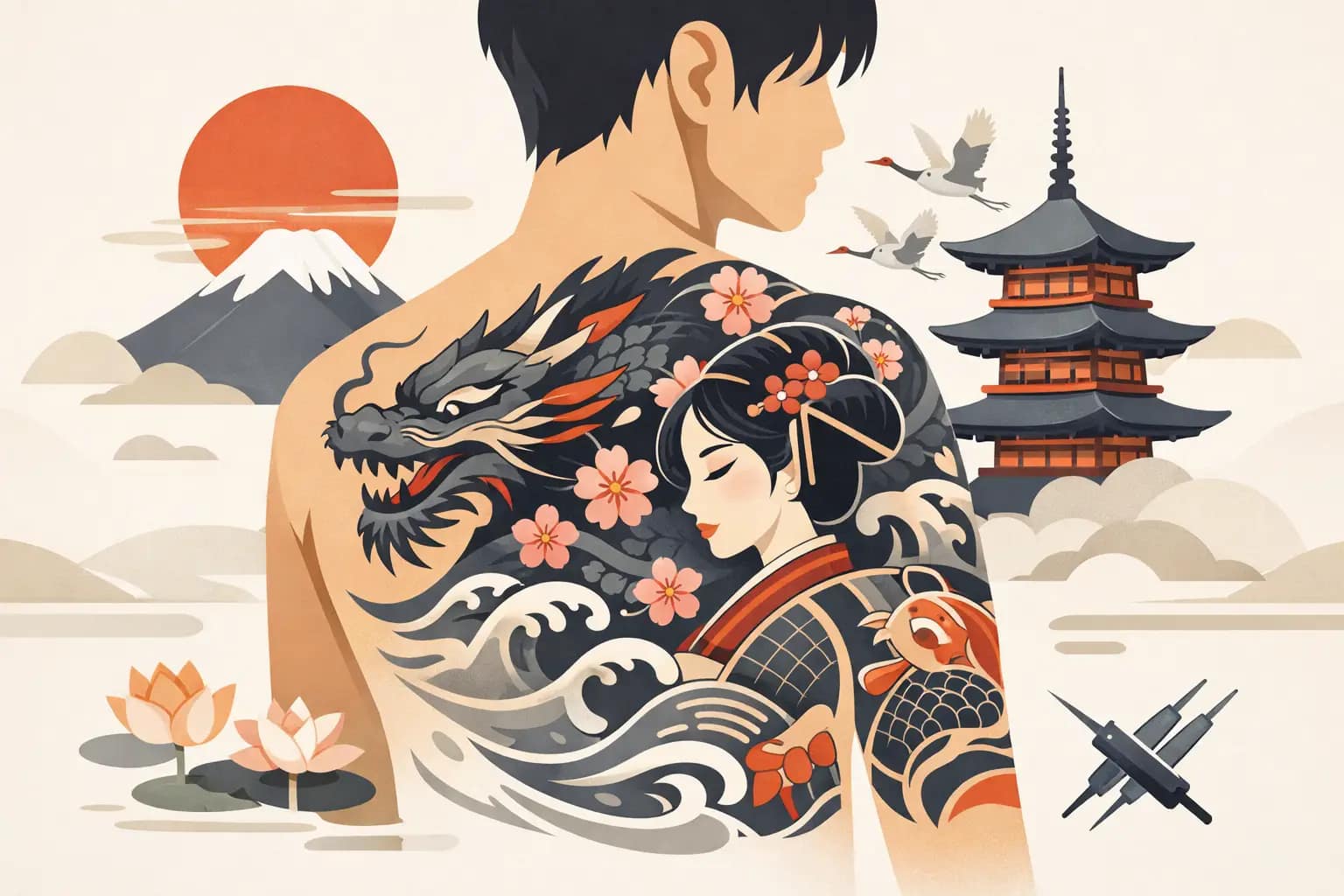
In Japanese and Neo-Traditional work especially, motifs carry visual and symbolic weight at the same time. A koi, chrysanthemum, hannya, crane, or panther is not just decoration. Each has movement, mood, and storytelling potential. That gives the final piece more depth than a single isolated icon floating on the skin.
Let the style guide the motif
One of the biggest mistakes people make is choosing imagery without considering style. A motif that works beautifully in Japanese tattooing may feel weak or awkward if translated into a different approach. The reverse is also true.
Japanese-inspired work favors motifs with flow, rhythm, and a relationship to the body. It often shines with larger imagery, layered symbolism, and background elements that help the design move with the anatomy. Neo-Traditional tends to push bold color, clear linework, and stylized forms with strong visual identity. Some motifs thrive in those structures. Others do not.
If you’re drawn to a particular tattoo style, choose motifs that belong there naturally. Do not fight the language of the style. A design reads better when the motif and the artistic approach are speaking the same language.
This is also why reference images can be useful but limited. They can help communicate mood, composition, or subject matter, but they should not replace an artist’s design judgment. What looks great in a square photo may not be the best solution for your arm, chest, back, or leg.
Think beyond symbolism and look at shape
A tattoo lives on a moving body, not a flat screen. That changes everything.
When choosing motifs, pay attention to silhouette, scale, and flow. Does the image have enough visual structure to hold up from a distance? Can it wrap a shoulder, fill a forearm, or anchor a larger composition? Will it still read clearly years from now?
Some ideas sound powerful but produce weak tattoos because they lack shape. Others seem simple on paper but become striking because they have bold movement and clean visual hierarchy. This is one reason classic motifs stay classic. They tend to be built on strong forms.
A tiger head, for example, carries expression, symmetry, and immediate readability. A koi offers motion and directional flow. Peonies and chrysanthemums bring texture and volume while supporting the main subject. Waves, wind bars, smoke, and leaves can tie everything together and create cohesion.
If your idea is highly specific, abstract, or sentimental, that does not mean it cannot work. It just means it may need interpretation. A skilled artist can translate your concept into a motif that still reads as a tattoo instead of an illustration trapped on skin.
Consider what will age well
A good motif should still feel strong after the excitement of the appointment wears off. That means thinking long-term.
Tiny details, overcrowded compositions, and trend-heavy imagery can lose impact faster than people expect. A custom tattoo does not need to be oversized to age well, but it does need enough room to breathe. Motifs with solid structure and clear contrast tend to hold their presence better over time.
This matters if you are planning a larger project or collecting work over the years. A motif should not only work today – it should give you room to expand later if you want to build a sleeve, back piece, or body flow around it.
When clients ask how to choose tattoo motifs, one of the most practical answers is this: choose something with staying power in both meaning and design. If you have to explain away concerns now, you will probably still be explaining them later.
Choose motifs that fit placement and scale
Placement is not an afterthought. It shapes the design from the beginning.
Some motifs are perfect for long vertical areas like the forearm, shin, or side of the calf. Others need broader space, like the chest, thigh, or back, to really open up. Circular motifs can work well on shoulders or knees. Designs with motion can follow the arm or wrap the ribcage in a way that makes the piece feel alive.
This is where compromise sometimes comes in. You may love a certain motif, but if you want it in a very small or awkward placement, the design may lose what makes it special. That does not mean giving up the idea. It means adapting it intelligently.
A good consultation should help clarify that. The strongest custom work is not about saying yes to every request exactly as imagined. It is about shaping the idea so the final tattoo actually succeeds on the body.
Avoid chasing trends you don’t truly connect with
There is nothing wrong with being inspired by current tattoo culture. The issue is choosing motifs because they are everywhere, not because they belong to you.
A motif should still make sense when the trend cycle moves on. Ask yourself a simple question: would I still want this if I had never seen it online? If the answer is no, pause there.
This does not mean every tattoo must be solemn or deeply symbolic. It just means there should be a reason beyond social proof. Maybe you love the history of the imagery. Maybe it matches your aesthetic. Maybe it reflects a part of your identity you want to wear openly. That is enough. It just has to be real.
Bring direction to the consultation, not a finished blueprint
The best client consultations usually begin with clarity, not control. You do not need to arrive with a fully solved design. In fact, that can sometimes limit the result.
What helps most is bringing a few clear anchors: themes you care about, motifs you are drawn to, placements you are considering, and examples of what you like stylistically. Then let the artist do the job of translating that into a tattoo that feels cohesive, balanced, and original.
At Dani Olmos Tattoo, that collaborative process is where many of the strongest pieces begin. The goal is not to force your story into a generic symbol. It is to build artwork that reflects your vision while respecting the craft, the body, and the long life of the tattoo itself.
If you’re choosing a motif right now, give yourself enough time to notice what keeps returning. The right image usually has both pull and clarity. It feels visually right, personally honest, and built for the kind of tattoo you will still be proud to wear years from now.